TripSync - AI Group Trip Planner
Built AI-powered coordination platform transforming group travel planning through intelligent preference synthesis, collaborative decision-making, and integrated booking orchestration—reducing planning time from 10 hours to 10 minutes.

Abstract
Impact: 90% time reduction. It turned 12-plus hours of group-trip planning into under five minutes and got more trips over the line. The real lesson: when the bottleneck is coordination rather than information, orchestrating the workflow beats generating more content.
The Challenge
Planning a trip with friends should be the fun part. Instead it’s usually where the trip quietly falls apart. 89% of group trips hit a snag over budget, dates, or what to actually do, and the average group burns 12+ hours getting through it — scattered across group chats, half-finished spreadsheets, and a dozen open booking tabs.
And it’s not for lack of recommendations. Google, TripAdvisor, and Wanderlog have that covered. What actually breaks a trip is coordination — getting six people to agree and book before the whole thing loses steam. That doesn’t scale past two or three people, and no amount of better hotel suggestions fixes it.
Our Approach
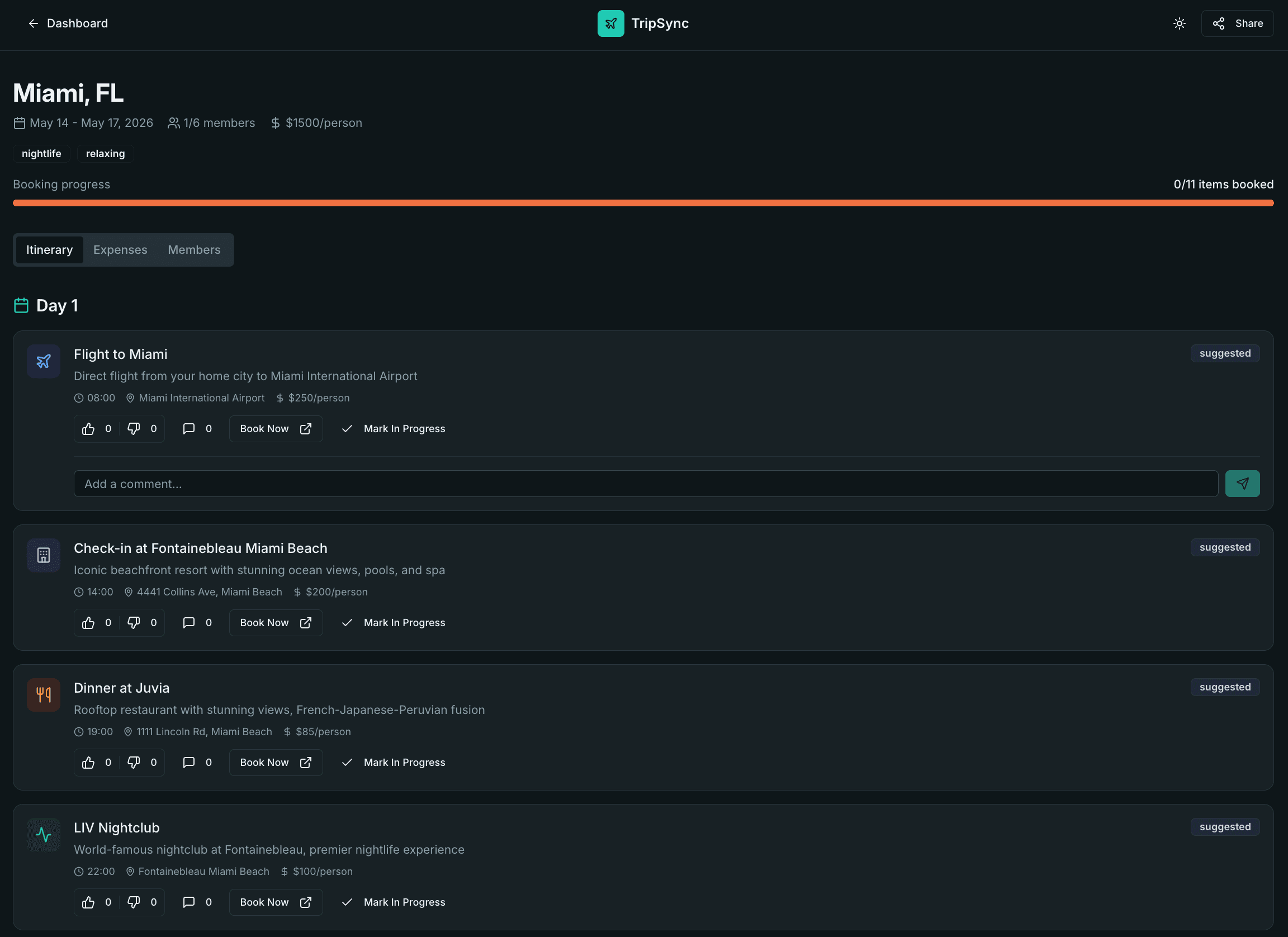
So TripSync doesn’t try to be a smarter recommendation engine. It runs the entire decision, start to finish: everyone drops in what they want, the AI shapes that into one plan the group can react to, a lightweight vote settles the disagreements, and expenses split themselves once the trip actually happens.
Sitting on top is Atlas, a conversational assistant that quietly watches the trip — nudging when the budget starts slipping, when a vote’s been stuck too long, or when the plan is drifting — and it learns each person’s taste as it goes. The AI proposes and mediates; the group always casts the final vote.
Technical Implementation
Itinerary generation — Claude Sonnet 4.5. A structured prompt takes the destination, dates, budget, group size, and everyone’s preferences and hands back a day-by-day plan that’s already balanced against the budget, in clean JSON the app renders directly.
Atlas assistant — Sonnet 4.5. Every conversation carries the full trip context — the itinerary, each member’s preferences, the live voting state — and a health-scoring layer decides when Atlas should step in rather than wait to be asked.
Receipt OCR — Claude Haiku 4 (vision). Snap a photo and Haiku reads the line items at roughly 92% accuracy, so splitting the bill doesn’t mean typing anything in.
Routing and cost control. Sonnet does the reasoning-heavy work, Haiku takes the high-volume simple jobs, prompt caching trims repeated context by around 80%, and confidence thresholds stop the model regenerating when it doesn’t need to — which is what holds the whole thing at about $0.12 a trip.
Results & Impact
Business Impact
Planning that used to eat 12+ hours now takes under five minutes. Atlas resolves 78% of split votes with a compromise the group actually accepts, and the trips it watches over are 34% more likely to happen. All of it runs at roughly $0.12 of AI per trip — about 4% of what a Pro subscription brings in.
Technical Excellence
Under the hood: a React 19 + Vite front end on a type-safe Node/Express and Drizzle/PostgreSQL back end, holding sub-50ms API responses at the 95th percentile, an 80% Redis cache-hit rate, and 90+ Lighthouse scores — all shipped as an installable PWA that’s WCAG 2.1 AA accessible, GDPR-compliant, and security-hardened.
My Role
Technologies
Key Metrics
The engineering decisions behind the AI
Where AI earns its place and where it doesn't, the models I chose and passed on, and how I measure hallucination and keep it honest. Here's the shape of it — the full detail is one click away.
Where AI earns its place
AI handles the synthesis and the tie-breaking — the parts people can’t do at scale. The booking nudges stay a plain rule, on purpose.
The models, and the ones I passed on
Sonnet 4.5 for nuanced group synthesis, Haiku 4 for cheap high-volume OCR — with the honest reasoning for everything I didn’t pick.
Hallucination, actually measured
How I define and calculate it, where it still slips through today, and what fixing it costs.
Interested in learning more?
I'd be happy to discuss this project in detail and explore how similar approaches could benefit your organization.